
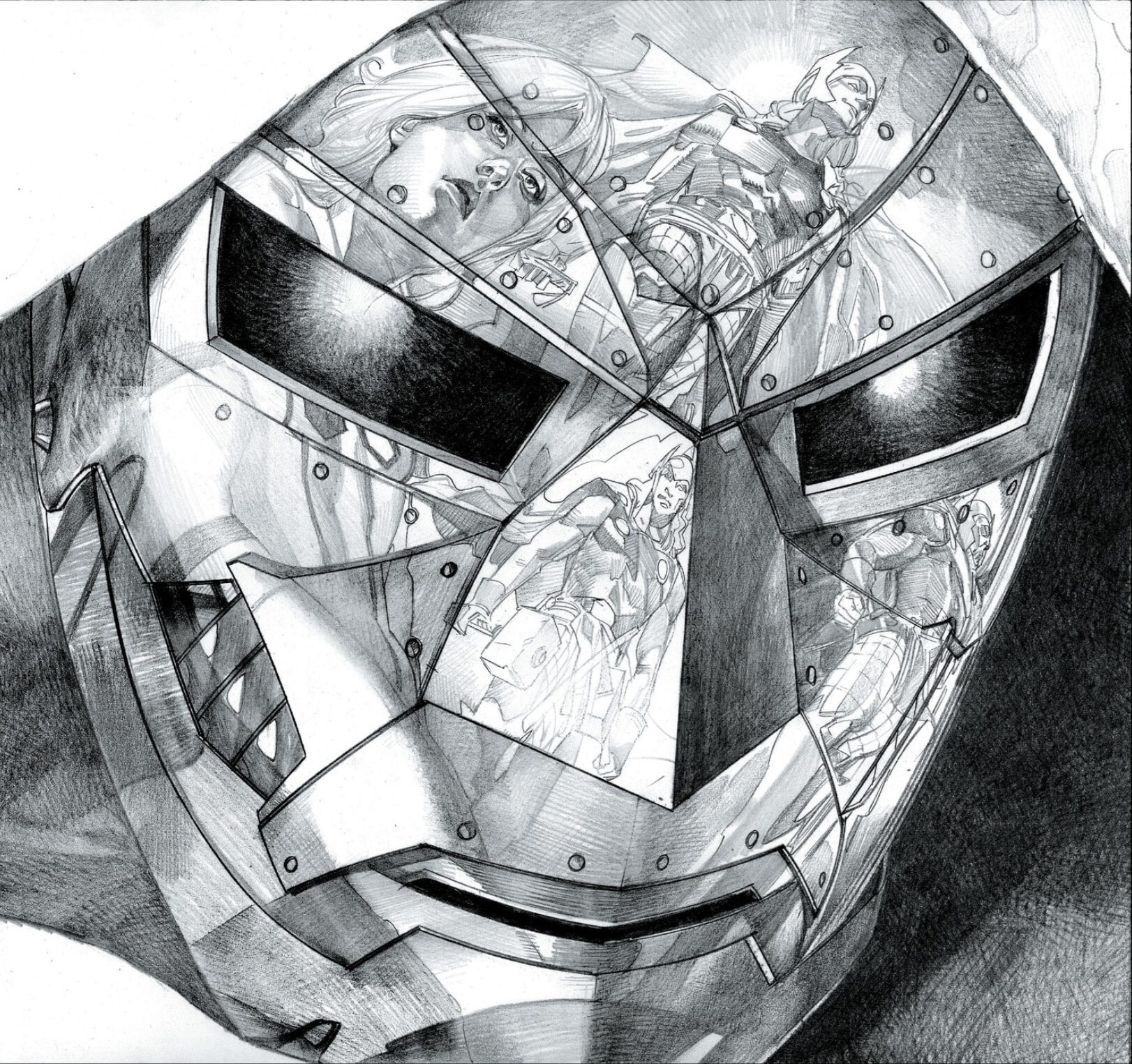
Canonically, Victor von Doom achieved his reign over the cosmos as God Emperor Doom in Jonathan Hickman’s 2015 run of “Secret Wars” and then went on to take over the mantle of Iron Man in Brian Michael Bendis’ “Infamous Iron Man” in 2016. However, I believe that based on what we’ve seen in the trailers so far, Feige and the team at Marvel Studios might be positioning Doom not as a tyrant seeking godhood, but as a reluctant protector whose methods push him into conflict with the heroes. Though, because we know how Secret Wars goes, we know that Doom inevitably becomes the tyrant deity.
What We Know (Sort of)
One. A couple of weeks ago, I saw a picture that I can’t seem to find again; it depicted Anthony Mackie’s Falcon flying some kind of plane or craft. My initial impression was that it was a Fantastic Four vehicle, though I don’t immediately recall why I thought that. There are four other people in the craft with him, one of which is Wyatt Russell’s U.S. Agent. Two others are sitting down, and the figure standing between the back two seats looks like Doctor Doom. If Doom is traveling with Falcon and U.S. Agent, that implies he’s aligned with them, at least temporarily, which fits the idea of Doom beginning as an uneasy ally rather than an outright villain.
Two. The scene from the Doomsday trailer where Professor X is looking out the window at the bright lights in the sky; that’s an incursion. This hasn’t been officially confirmed, but in my mind it’s the only possibility for something that big that’s not an explosion. Two realities are colliding because anchor beings paramount to the furtherance of those realities are moving (or being moved) between realities and throwing everything off kilter at a cosmic scale. If Doom is involved, it stands to reasons that he may be either causing the destabilization or attempting to prevent it. Both of which potentially align with his (occasional) comic history of making morally brutal choices for the greater good.
(Note: Anchor Beings, for the casual reader, are beings central to a particular timeline as introduced in Season 1 of the Loki series. Or like Wade and Logan in the Deadpool & Wolverine movie.)
Three. Next up, we’ve got David Harbour (Red Guardian) revealing his ‘out of context’ line from Doomsday “You’re… Tony Stark!” There is genuinely zero context for this line, but it fits neatly into this theory.
Four. Last, I’d like to draw your attention to this Endgame deleted scene of Tony immediately post-universe saving snap. He meets Morgan, who tells him she’s proud of him.
Specifically, though, I want to highlight Morgan’s comment “I know it’s gonna be tough for you to let go.” And we all know Tony Stark is nothing if not tenacious. Who would he be if he let a little thing like death get in the way of protecting the ones he loves?
What The Comics Tell Us
In Infamous Iron Man, Victor von Doom explains his origins as a homeless Roma with a dark witch for a mother, and how he clawed his way toward a life of leadership, science, and sorcery to achieve his dream of ultimate power. He talks about becoming the God Emperor Doom of Battleworld, but that he quickly discovered its flaws due to his creating that universe in his image and that ‘no man is God, and God is not man.’
He explains how becoming a God did not change him, and that this realization led him on the path to rethinking his purpose; if the act of ultimate power was not his true calling, maybe the opposite could be true. A life dedicated to protecting instead of conquering.
Doom goes on to describe his eventual inclination towards the good side of the super-spectrum in a post Secret Wars universe like this:
“I looked out to my true peers. To Reed Richards, Tony Stark… and as I looked to them, I studied them with fresh eyes and I saw a new purpose. A better purpose.
But in what form? That, I would need to consider.
I then realized that my life up until now had put me in close contact with some of the worst people on this planet. But maybe that is what all my time as ‘Doctor Doom’ was preparing me for.
I knew who the monsters were, where they were and what they were capable of. I could right so many wrongs quicker and more efficiently than anyone else, because I was once the worst of them all.
I came to Tony Stark because I admired him. I always looked at him and saw another version of me. And when he fell, I knew the Elders of the Cosmos were telling me what form my penance would need to take. I would be Iron Man.”

Doom’s realization here, in a way, mirrors one of Tony’s biggest complexities; repeated attempts to fix the world through extreme measures (Ultron, the registration act that led to the events of Civil War, etc). Doom admiring Tony creates a natural bridge for the MCU to adapt the Infamous Iron Man storyline, whether that be in part or in whole.
What the MCU Might Do
The Endgame deleted scene of Tony and Morgan is the quiet lynchpin of this entire theory. Morgan’s line (“I know it’s gonna be tough for you to let go”) reads almost like a meta‑commentary on Tony’s most defining trait: he never stops building safeguards. Ultron, the mark suits, his support of the registration act, EDITH, etc. Tony’s legacy is contingency planning, and a little thing like death wouldn’t stop that. If anything, it would force him further to create more robust and comprehensive failsafes.
The most elegant MCU adaptation of Infamous Iron Man would be Tony leaving behind an AI version of himself that ends up in the hands of Doom and enables him to become the MCU’s Iron Man successor, at least for a short while.
Now layer in the incursion.
If the bright lights Professor X watches are indeed two realities collapsing into each other, Doom’s involvement becomes inevitable. In the comics, Doom is often the only person willing to make the catastrophic choices required to stop destruction on a cosmic scale. The MCU could mirror this in posing Doom as an uneasy ally, trying to prevent or deter the incursion, but his methods quickly cross lines the Avengers refuse to cross. Preemptively killing the “monsters” he mentioned, sacrificing the few to save the many, or saving one world over another when the only alternative is that both worlds are destroyed. These instances are where I can see Doom breaking away from the other heroes.
However, this trajectory collides with the darker speculation from Sinister Signals. Doom proclaiming “Hell answers to me” after swatting Thor away suggests a supernatural angle more in keeping with Doom’s sorcery roots. And if the MCU pulls from the Infamous Iron Man story, Cynthia von Doom’s return becomes an even more tempting thread.
In the comics, she’s manipulated by The Maker, an evil Reed Richards variant, during the events of Infamous Iron Man. Within the contemporary MCU continuity, Cynthia could also feasibly have been a victim of Agatha Harkness, given the actual MCU origins of “The Road”. However, I believe the most likely option is that Doom is ultimately gunning for Mephisto, who is the one that trapped Cynthia’s soul in Hell.
In Conclusion…
Taken together, Falcon flying the (presumably) Fantastic Four craft, the incursion imagery, Red Guardian’s out-of-context Tony Stark line, Tony’s lingering AI potential, and Doom’s comic arcs, a clear pattern begins to emerge.
The MCU appears to be building Doctor Doom up not as a one-note tyrant but a multi-faceted opponent who blurs the lines between friend and foe. If Doom begins as an ally, guided by a Stark‑like AI, trying to prevent a multiversal collapse, his fall becomes far more compelling. He doesn’t turn evil; he becomes necessary (inevitable, if you will). And necessity is the first step toward tyranny.
Regardless of the inroads, Doom is being positioned to become the emotional and philosophical center of the Multiverse Saga; a man who tries to save everything, fails, and then decides the only solution is to rebuild reality in his image.